

In the FCIS report – warrying trends of concern to professionals, the number of STR’s is further rapidly increasing
The Money Laundering Prevention Division of the Financial Crime Investigation Service introduced the annual activity report of the Division. It includes the traditional analysis of money laundering prevention, the information on international cooperation and cooperation with the other institutions of Lithuania, the legislative innovations in the sphere of money laundering prevention, other statistic information.
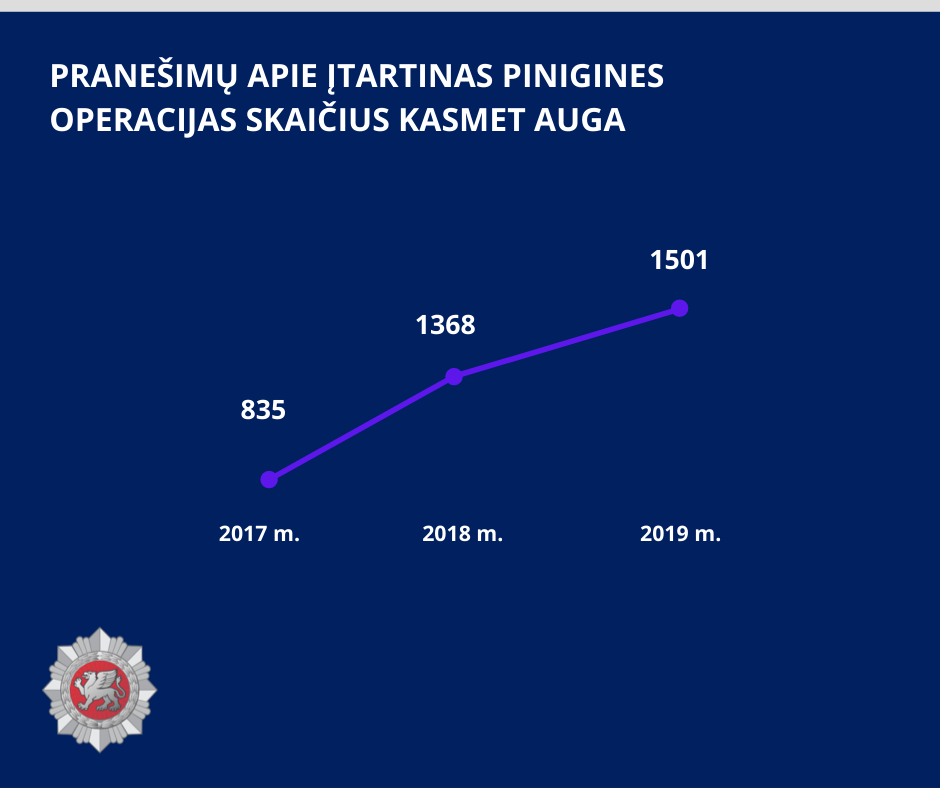
It is stated in the report that in 2019 the number of STR’s further increased: if 5 years ago there were a little bit more than five hundred of such reports, so presently this number has increased nearly three times. Last year the Money Laundering Prevention Board received the total number of 1501 reports on suspicious operations with money or transactions, or 10 per cent more than in 2018. The reports were submitted by different financial institutions, state institutions, other authorized subjects, FIU’s. Nearly half of the received reports were from the bank sector – the banks are obliged to follow the requirements of the prevention of terrorism and money laundering and to report to the institutions about the slightest suspicions.
It should be noted that in 2019 the number of the reports increased about the companies dealing with cash transfers. The number of the reports from casinos significantly decreased. As the Bank of Lithuania recently issued a large number of licences to the new financial market participants –institutions of electronic money and payment institutions, specialized banks, so respectably the larger number of the aforementioned subjects, following the established norms, started sending the reports about the least suspicious financial operations and transactions. After the assessment of the received reports on suspicious financial operations or transactions it has been determined that the larger part of primary crimes, i.e. the crimes, as a result of which the property was acquired, legalized or attempted to be legalized, consisted of tax crimes and swindling.
“Implementing the clients monitoring, more reports were submitted about the suspicious financial operations or transactions of the natural (over 860) and the legal (over 500) persons of Lithuania. However, in 2019 the number of the reports increased, in which the main subjects are foreign naturals (over 530, in 2018 – 340) and legal (over 316, in 2018 – 250) persons. The aforementioned reports were sent by the electronic money institutions, in the accounts of which the financial transactions between the foreign nationals took place. Moreover, large part of the reports was related to swindling through different online platforms (e.g. eBay, On-line trading platform etc.)” – says Vilius Pečkaitis, Head of the Money Laundering Prevention Board of the Financial Crime Investigation Service.
124 reports on suspicious financial transactions were received in the accounts of the reporting entities in 2019. The amount of the suspended financial transactions is more than 37 million EUR (in 2018 over 26 million EUR, among them in respect of 8 million EUR temporary ownership rights restriction was applied afterwards according to the Code of Criminal Procedure.
Receiving the reports on suspicious financial transactions, the Money Laundering Prevention Division identified the following tendencies: social engineering fraud, fraud using electronic currency, suspicious cash operations, using fictitious companies, suspicious cash transfers, using the so-called quick payments.
“In 2019 the tendency of social engineering fraud remained, however it must be admitted that the fraudsters become more inventive: for example, if previously the reports were received about that type of swindling using the psychological manipulation and hypnosis (mostly during the phone calls), so lately the information is received about the illegal burglary into the electronic communication of entities, pretending to be a partner or requesting to direct financial payments to other credit institutions or the accounts opened in them. For example, the accountant is persuaded that the entity owes the money, and under the influence of such a fraud he makes the payment to the company, which in reality does not provide any services or goods. The accounts opened in the banks of the recently registered Lithuanian companies are also used by the criminals, in which no significant financial operations, payments, related to any business activity are made, no payment transfers to the employees are effected etc. Such companies usually do not have any employees, and the managers of the companies opening the accounts in the banks, are young people or foreigners”,- says Mindaugas Petrauskas, Deputy Director of the Financial Crime Investigation Service.
According to Mindaugas Petrauskas, it is notable that the amounts obtained by fraud have decreased significantly, which previously amounted at hundred thousand EUR, and now they are of thousand or ten thousand EUR, however the number of such fraudulent transfers has increased.
In 2019 there were more cases, whenever it was sought to give away the money from the Lithuanian and foreign natural persons, offering to purchase the ostensibly existing virtual currency. Using for that purpose the advertisements created and announced on the websites specifically designed for that purpose, it is offered to “invest profitably” the funds into the financial institutions providing investment services, virtual currency exchange, which receive such payment transfers to the accounts opened in Lithuania as well.
Whenever a natural person makes a phone call according to the advertisement, he is offered to open an account, to transfer to it from several hundred up to several thousand EUR, afterwards the money is ostensibly invested into virtual currencies. In reality no investment is done, and the money is just being fraudulently misappropriated. The persons, understanding that they have lost their personal money, appeal to the financial institutions with the request to return the lost money as a result of fraud.
By the way, the bank accounts opened by the Latvian natural and legal persons for illegal activity in Lithuania, recently were changed mostly by the Ukrainian citizens, who open their personal accounts or buy the companies registered in Lithuania. Afterwards large amounts of money inflow into the bank accounts, which are invested into immovable property or are used as transit funds, transferring them to other (EU) countries.
The Money Laundering Prevention Division of the FCIS makes its report annually, it can be found on the webpage of the Service www.fntt.lt.